

There are places in the ocean that cannot simply be seen in a photograph and yet completely change the way we understand the planet. They have no coastline, no nearby port, and do not appear on anyone’s usual routes. We’re talking about Point Nemo: what is it, where is it, and what happens there? Why has it become such a striking reference?
Let’s find out! At Motyvel, we reveal all the secrets of this intriguing point in the ocean and its importance for navigation.
Point Nemo: what is it and why is it called that?
Point Nemo is the oceanic pole of inaccessibility: the point in the ocean that lies farthest from any coastline. In other words, if you measure the distance from that point to the nearest landmasses, none are close. It is, by definition, the “center” of the planet’s largest expanse without land.
The name “Nemo” is often associated with the idea of “no one” (in Latin) and also with popular sea-related culture. Its name makes sense because it is a point that, in human terms, is almost always empty. It is not an island or a reef: it is a coordinate, a place that exists because we can measure it.
From a nautical and cartographic perspective, understanding Point Nemo and what it is helps explain something important: the sea is not only sailed, it is also defined with mathematical tools. Point Nemo is a good example of how a cartographic concept can become famous for what it represents.
Where is Point Nemo on the map?
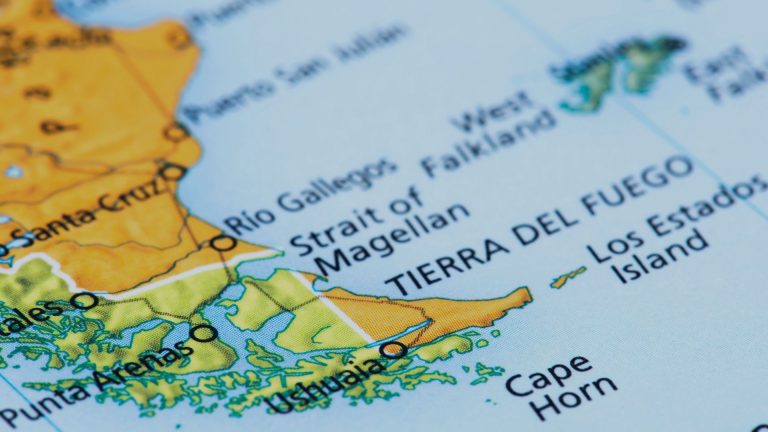
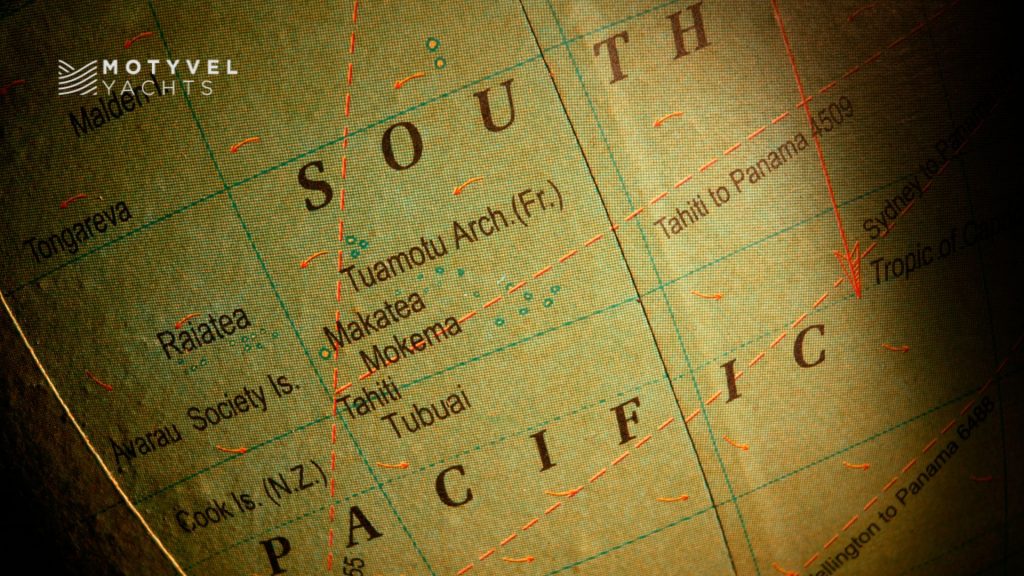
Point Nemo is located in the South Pacific, in an area of very open and rarely traveled waters. Its relevance does not depend on a specific coastline, but on its relative position to several distant landmasses.
In fact, Point Nemo lies in a part of the world where there are usually no natural stopovers and where logistics make any detour complex.
Why is it considered the most isolated place on the planet?
The isolation of Point Nemo is a consequence of its definition. On land, there are poles of inaccessibility (places very far from the sea). In the ocean, Point Nemo is the equivalent: very far from any coastline.
In practice, that isolation translates into several realities:
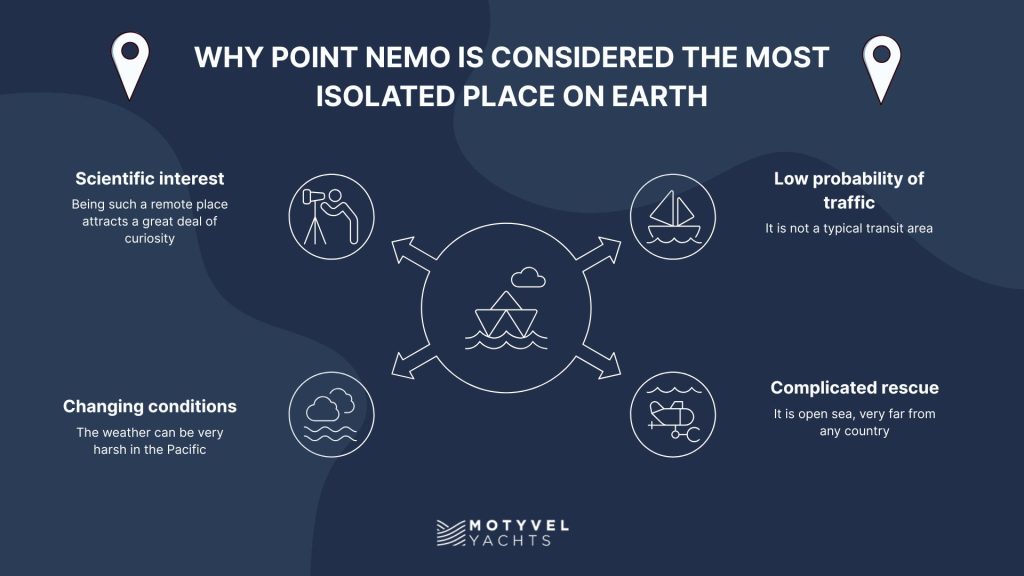
- Very low probability of nearby traffic: it is not a typical area for commercial navigation or common leisure routes.
- Complicated rescue and assistance: in the open ocean, distance determines everything. The farther away you are, the harder it is to receive quick help.
- Changing conditions: the South Pacific can be harsh; even with good planning, the sea is in charge.
- Scientific and symbolic interest: it has become the ultimate remote place, a label that sparks curiosity.
What is at Point Nemo?
A point of open water, with no islands or structures
Point Nemo is pure ocean. There is no island marking it, no official buoy, no lighthouse, no port. It is a place identified by coordinates, like many other points in navigation.
If you imagine arriving there, what you would see is ocean stretching to the horizon. The only reference would be your instruments: nautical charts, GPS, plotter, compass, and position verification.
Marine life and ecosystem: what we know
In the open ocean there is always life, from microorganisms to pelagic species, but the presence of some or others depends on factors such as currents, temperature, nutrient availability, and biological routes. At such a remote point, it cannot be stated that “species X” is present without specific data, but it is reasonable to understand that this is pelagic ocean, with dynamics typical of the open sea.
Remains of human activity
The area around Point Nemo is often described as a remote zone where remains of satellites or space stations have fallen. The logic is simple: if you have to choose an area to minimize risk, you select a place with very low human presence. Even so, it is important to be clear about something: it is not a visible “dumping ground” or a place with floating debris. If there are remains, they would be dispersed, sunk, or at great depth, and there is no surface sign revealing them.
What happens at Point Nemo?
On a day-to-day basis, the most common thing is that nothing special happens at the surface. There is no fixed phenomenon associated with the point itself. What does happen is that isolation shapes everything:
- A vessel sailing there depends almost entirely on its preparation.
- Satellite communications may be the only line of contact with the outside world.
- Weather plays a huge role because there is no nearby “plan B” in the form of a port.
The experience from a navigation perspective
For a crew, passing through such a remote area is a matter of planning rather than bravery. In boating, prudence shows before setting sail: vessel condition, spare parts, energy, water, alternative routes, timing, and protocols.
Why doesn’t NASA investigate Point Nemo?
There is no single reason that requires it to be “investigated” as if it were an anomalous site.
1) It is not an object, it is a coordinate
Point Nemo is not a structure or a unique physical phenomenon. It is a point defined by its distance from land. That means that, from a space science perspective, it is not a “target” in itself.
2) Space-related interest is usually in the atmosphere and orbit
NASA and other agencies work on missions with very diverse objectives, but research usually makes sense when there is a hypothesis or a technical need. The remote open ocean may be relevant for reentry operations and safety, but that does not mean it is a permanent laboratory.
3) Logistics and operational cost
Any campaign in such a remote area requires major logistics: support vessels, weather windows, safety measures, communications, personnel, and long timelines. Without a clear scientific objective, it is not a natural priority.
Which country is closest to Point Nemo?
Point Nemo is closer to small islands (insular territories) than to large continents. The point is relatively nearer to insular territories in the South Pacific belonging to certain states, but it does not belong to any country, as it lies in international waters.
If you need it for a general informational piece, the correct idea is: there is no nearby country in the everyday sense; the closest references are islands that are extremely far from each other and from the rest of the world.
Is it possible to visit Point Nemo?
Yes, but it is not a tourist plan. One thing is possible and another is reasonable, since visiting Point Nemo implies:
- A vessel with true ocean-going autonomy.
- Safety preparation (equipment, life rafts, communication, protocols).
- Weather planning and time windows.
- A contingency plan: what to do if something fails.
- Offshore sailing experience.
Why many people don’t attempt it
Because in navigation, distance equals risk—and risk without purpose is a bad idea. Moreover, in the open ocean there is no quick assistance, no repairs, no shelter. And for any sensible sailor, that weighs more than curiosity.
Still, if you search for “Point Nemo what is it,” it is normal to also wonder whether it can be reached. The answer is yes, with the right means and experience—but not as a routine activity.
Why Point Nemo interests so many people
- Because it is an easy concept to grasp: the most remote place in the ocean.
- Because it combines science, maps, and the sea.
- Because it raises questions about logistics, survival, and exploration.
- Because, although it is just a coordinate, it represents a human limit: distance.
The map also has impossible places
So, Point Nemo: what is it? It is not a secret island or a hidden mystery: it is a coordinate that shows just how immense the ocean can be. It is the point farthest from land, a symbol of oceanic isolation and a reminder that, at sea, distance changes everything.
Are you thinking about setting off on an adventure—even if not to Point Nemo, but across the most spectacular waters of the Mediterranean? That’s better: less epic, more swimming… and far fewer chances of drifting aimlessly. At Motyvel, we help you plan your route, solve navigation questions, and set sail with the peace of mind that everything is properly arranged.
We offer boats for charter and sale from the most prestigious brands such as Pardo, VonDutch, Jeanneau, Grand Soleil and YOT. You can depart from any of our ports in Sant Andreu de Llavaneres (Barcelona) or Port Adriano (Mallorca). Contact our team today.