For centuries, the southern seas have challenged the boldest navigators. Their unpredictable currents and hostile landscapes have witnessed stories of exploration, bravery and discovery. Today, those seeking alternative routes to the open oceans find a unique challenge that combines history and adventure: the Strait of Magellan.
But where exactly is it located, what makes it such a demanding route, and why does its uniqueness endure over time?
At Motyvel we understand boating from a practical perspective: buying and selling new and pre-owned vessels, charter services and full service (mechanical assistance for any unexpected issue your boat may experience). This time, we are writing about the Strait of Magellan: where it is, what it connects, why its navigation is known for being demanding, the role it has played in maritime history, and why today it continues to be a reference point for sailors around the world.

Where is the Strait of Magellan and what does it connect?
The Strait of Magellan is a natural passage at the southern tip of South America. It lies between mainland Chile (to the north) and the Tierra del Fuego archipelago (to the south). It is a navigable route that links the Atlantic and Pacific Oceans through a long and winding inland corridor.
A long corridor, with very narrow sections
In terms of scale, it is impressive: the strait stretches approximately 570 km and at its narrowest point it can be around 2 km wide. This combination (great length and changing width) is one of the reasons navigation is difficult. There are wide stretches and others where channel reading and course management become crucial.
What alternative does it offer compared to the great southern ocean
For those looking at the map thinking about the jump between oceans, the Strait of Magellan appears as a more sheltered option than the open route that rounds Cape Horn via the Drake Passage. It is also a historically relevant corridor because, before the Panama Canal, it was one of the most used routes for maritime traffic between the Atlantic and Pacific.
Why navigating the Strait of Magellan is so demanding
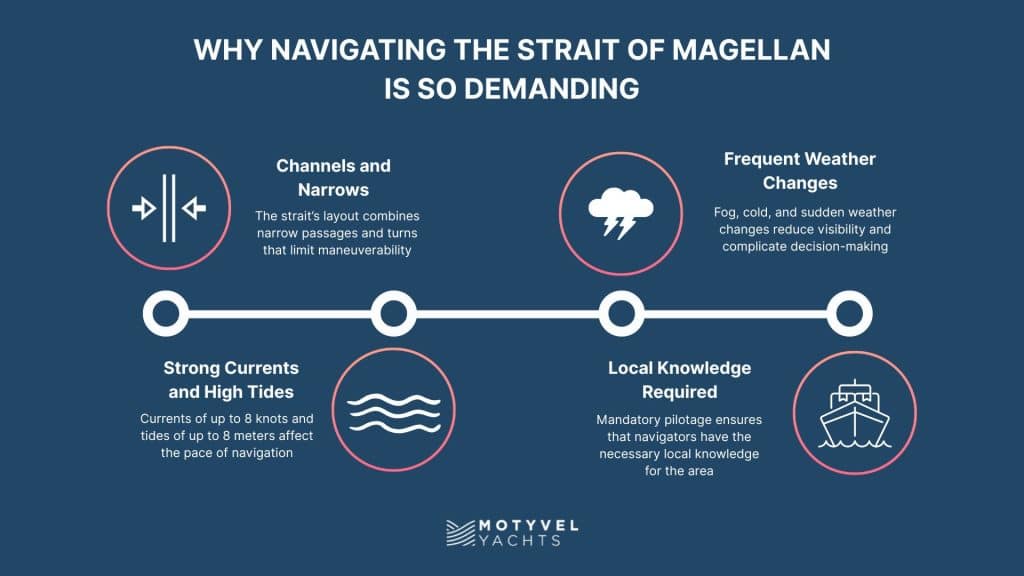
The reputation of the Strait of Magellan comes from the combination of channel navigation, southern hemisphere weather, and a tidal and current regime that can change day by day.
Channels, narrows and limited maneuverability
The route is not a straight line. The strait combines narrow passages, turns and sectors where maneuvering margins are reduced. This reality is noticeable in practice: when the channel narrows, any crosswind or pushing current forces earlier anticipation, and decisions must be made with less available distance.
Currents and tides: when the water sets the pace
In the Strait, tides are not a minor detail: it is an area heavily affected by currents and tides, with maximum values that can reach 8 knots of current and 8 meters of tidal range during spring tide conditions. All of this translates into something very practical: the same stretch can feel different depending on the tidal phase, and planning transit windows can make the difference between a comfortable or a tense passage.
Sudden winds and weather changes
To the channel’s difficulty is added the southern character: fog, cold and frequent weather changes appear repeatedly in descriptions of the passage. From a navigation standpoint, this affects both visibility and decision-making: when the weather shifts, channel reading and speed management become even more important.
Pilotage and navigation rules
It is no coincidence that mandatory pilotage is discussed in this corridor. From a navigator’s perspective, this reflects something simple: the place requires local knowledge, and maritime authorities organize traffic to reduce risks in a complex area.
The historical footprint of the Strait of Magellan
Talking about the Strait of Magellan means talking about maritime history. Its relevance cannot be understood without the context of the centuries when crossing oceans literally meant opening new routes through risk and patience.
From “discovered” passage to interoceanic route
The expedition of Ferdinand Magellan was the first European one to cross the passage in 1520, connecting the Atlantic and Pacific through a natural route. That voyage changed practical cartography: it finally confirmed that a navigable route existed.
Before the Panama Canal: a key corridor
For centuries, the strait was one of the preferred routes for sailing ships to connect oceans, especially before 1914, when the opening of the Panama Canal offered a more direct passage for many shipping routes. Even with Panama operating, the strait never disappeared from the maritime map: it remained an option for certain itineraries and scenarios.
Punta Arenas and life around the channel
In the history of traffic through the strait, the role of Punta Arenas stands out as the main port in the area. Although each era has had its own economic logic, in nautical terms the value of such a port is clear: shelter, logistics, support and a reference point for an area where climate and distance matter.
Why is it called the Strait of Magellan?
It is named after Ferdinand Magellan, the Portuguese navigator serving the Spanish Crown whose expedition crossed the passage in 1520.
The original name: All Saints
An interesting historical detail is that Magellan initially named it Strait of All Saints. That name is linked to the calendar moment when he began crossing the channel. Over time, and by decision associated with the Spanish Crown, the passage was renamed the Strait of Magellan in his honor.
Why is the Strait of Magellan important?
The importance of the Strait of Magellan is sustained by geography, history and maritime strategy.
Natural connection between two oceans
At a basic level, it is a natural connection between the Atlantic and Pacific. This makes it a corridor that, in certain scenarios, may be preferable to open routes in the far south, which are more exposed to storms.
An alternative that is returning to discussion
At times when other interoceanic routes are under pressure, the strait reappears in analyses and debates about maritime routes. The focus is usually on its value as a southern corridor under Chilean jurisdiction and its role as an option for part of maritime traffic.
A real navigation “exam”
Beyond commerce, the strait has symbolic value for navigators: it is not a route for rushing or improvising. It is a navigation that requires preparation, judgment and respect for a long, changing channel with sections that do not forgive mistakes.
Who owns the Strait of Magellan?
In terms of jurisdiction, the Strait of Magellan is under Chilean sovereignty along almost its entire length, and the description of the route itself places it in southern Chile.
A sensitive point: the eastern entrance and boundaries
In the easternmost area, the geographic relationship with Argentina appears in various descriptions of the area and its boundaries, but the practical regime of the strait and its maritime management are associated with Chile as the main corridor.
How many ships pass through the Strait of Magellan?
The answer depends on what is measured and how it is measured. For an official figure with defined criteria, it is useful to consult maritime statistics.
Official traffic data (large vessels)
The Maritime Statistical Bulletin, 2023 edition (2022 data) from Directemar publishes the maritime traffic (sightings) of large vessels in the Strait of Magellan during 2022: 2,664 total, broken down into 1,107 national vessels and 1,557 foreign vessels.
What is included and excluded in that count
The same table clarifies that these sightings are recorded through a radio system and that motorboats, sailboats and yachts are not included in that “large vessels” count. That is why it is normal to see different figures in general publications: not always the same type of vessel is being measured.
What makes the Strait of Magellan unique compared to other southern routes
The Strait of Magellan competes in the imagination with Cape Horn and the Drake Passage. But they are not equivalent: they are different experiences, with different risks.
Inland passage versus open sea
The strait is an inland route, with sheltered sections, while the Drake route is open sea and is usually associated with strong winds and harsh conditions. This difference explains why, historically, many sailing ships valued the strait as an alternative, even if it was not simple.
The “trap” of thinking it is easy
Being inland does not mean it is comfortable. The narrowness at certain points, the currents and changing weather are enough to turn a stretch into a serious test. In addition, the fact that pilotage is mandatory reinforces that idea: the place requires channel knowledge and very careful navigation habits.
When the map becomes experience
The Strait of Magellan is a long corridor, with narrow passages, strong currents and a climate that can change the situation without warning. It is also a place where the history of navigation can be understood without embellishment: it is enough to remember that one of the most famous interoceanic connections on the planet was confirmed here.
If you are attracted to routes with character, offshore navigation, or you are preparing a more ambitious nautical project, at Motyvel you can rely on a complete service: buying and selling new and pre-owned vessels, charter, maintenance, winter storage, moorings and administrative services. Write to us for a consultation and we will help you choose the right boat, plan how you will really use it, and prepare it so your next adventure starts on the right course.