The sea never stays still. Throughout the day, its level rises and falls almost imperceptibly, reshaping beaches, harbours, and coastal landscapes. This rhythmic movement has shaped navigation, fishing, and even the daily life of those who live near the shoreline for centuries. Understanding why it happens and how it shows up helps us read the ocean’s behaviour more accurately and anticipate its changes—especially when we talk about low tide and high tide.
At Motyvel we support those who enjoy the sea with a complete service for sales, charter, assistance, and maintenance of boats, with tailored solutions and a track record spanning more than three decades. Let’s look at what low tide and high tide are and how to use them to choose the best time to head out with more margin and peace of mind.

What are low tide and high tide?
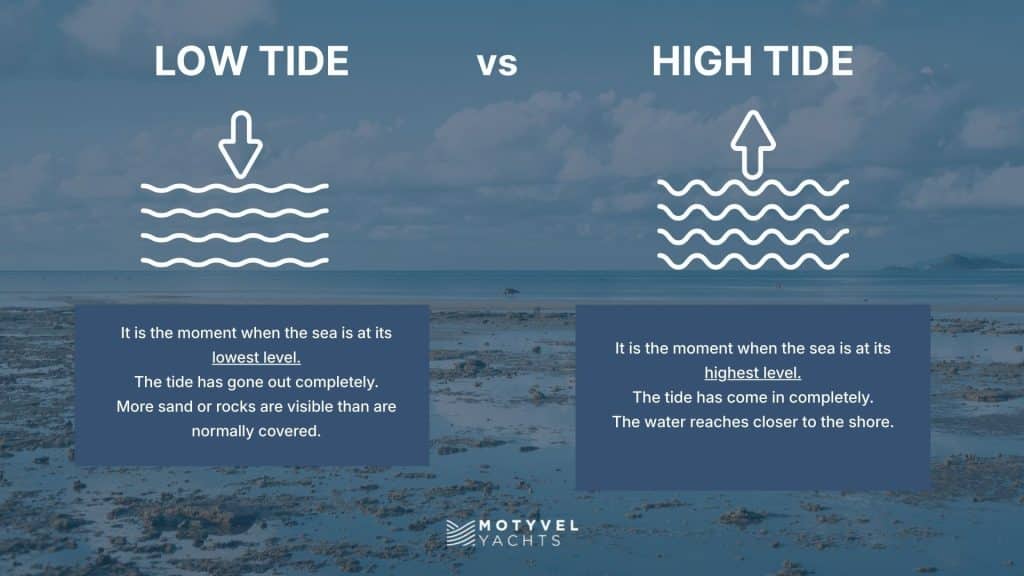
When we talk about low tide and high tide, we mean the two extremes of the tidal cycle:
- High tide: the moment when the sea reaches its highest level within the cycle.
- Low tide: the opposite moment, when the sea reaches its lowest level within the same cycle.
Between a high tide and a low tide, around half a cycle usually passes, and that rhythm repeats throughout the day. Beyond the vertical change in sea level, there is another effect that matters when boating: the horizontal movement of the water, i.e., tidal currents, which can affect manoeuvring and your effective speed over the ground.
When is low tide and high tide?
“Altamar” is sometimes used colloquially to refer to “high tide”, although in navigation it can also mean open sea. In the context of tides, what matters is knowing when high tide and low tide occur in your area.
Low-tide and high-tide times aren’t fixed: they change every day. Why? Because the tidal cycle follows an astronomical rhythm driven mainly by the Moon, and that “clock” doesn’t match the solar day exactly. That’s why high- and low-tide times shift day by day.
To find out, it’s common to consult a tide table for the nearest coastal point or the harbour you use as a reference. These tables publish, for each day, the times of high and low tide (and in many cases, the water height).
If you go out regularly, checking low tide and high tide should be part of your pre-departure routine, just like reviewing the forecast and sea state.
How do low tide and high tide happen?
The underlying explanation has a clear main driver: the gravitational pull of the Moon and the Sun on the Earth’s bodies of water. That pull creates a periodic oscillation in sea level: the tide.
The Moon has the primary effect because it is closer. The Sun also plays a role, and when both “pull” in the same direction, tides of greater range occur.
Spring tides and neap tides
- Spring tides (syzygy): occur near the new moon and full moon, when the Sun’s and Moon’s influence aligns and the difference between high tide and low tide increases.
- Neap tides (quadrature): occur near the first and last quarter, when the forces partly offset each other and the tidal range decreases.
This is very useful for planning, because low tide and high tide with a small tidal range isn’t the same as a day with a large range, when the level changes more and currents can strengthen.
Why two nearby harbours can have different tides
Although the driving force is astronomical, the local result depends on:
- Coastline shape and the orientation of bays and estuaries.
- Bathymetry (depth and seabed profile).
- Narrows, channels, harbour entrances, and areas where the water “accelerates” as it passes through.
How to interpret tide information for better boating
Knowing what low tide and high tide are is the starting point. What makes the difference is turning that into practical decisions.
What to check in a tide table
- High-tide and low-tide times: to calculate entry/exit windows or crossings of shallow areas.
- Water height (if included): helps you estimate available depth for your draft.
- Trend (flood or ebb): to anticipate currents, especially in narrow passes.
Why do low tide and high tide matter when boating?
Low tide and high tide affect boating in three very clear ways: available depth, currents, and manoeuvring.
1) Depth and draft safety
In some areas, at low tide, the clearance under the keel shrinks. In harbour entrances, channels, marinas, or anchorages with limited depth, choosing a window close to high tide can give you more water and less stress.
Also the other way around: on some beaches or anchorages, low tide exposes areas where you don’t want to end up “resting” if your boat can’t safely take the ground.
2) Tidal currents: your invisible engine (or your brake)
Beyond the rise and fall, the tide moves water horizontally: tidal currents. Offshore they can be less noticeable, but in channels, passes, and entrances they are very evident.
- With you, they help you make progress with lower fuel use.
- Against you, they reduce your speed over the ground and can complicate steering, especially with a crosswind.
3) Harbour manoeuvres and berthing
In harbours with a noticeable range, water height can change the boat’s position relative to the pontoon, the tension on mooring lines, and the angle of the gangway. While each facility has its own design, the tide may require closer attention to line adjustments, especially on days with a larger range.
4) Visibility of hazards and reading the seabed
At low tide, rocks, shoals, and parts of the shoreline appear that are hidden at high tide. To get to know an area properly, observing it at low tide can provide valuable information about what lies beneath the surface—always with caution.
How to choose the best time to go out based on your plan
There is no universal “best time”: it depends on your route, your boat, and the type of coastline. Still, there are criteria that almost always help.
If you’ll be passing through shallow areas
It is usually more comfortable to depart or enter close to high tide, when more depth is available. Here, low tide and high tide define your operating margin.
If your priority is to reduce fuel use and gain speed
Consider the direction of the tidal current along your leg. If you can time part of the trip with a favourable current, the passage is usually smoother.
If you plan to anchor
Ask yourself: what will your boat be like at low tide? Will there be enough water under the keel? Will the boat move too close to shore as the level changes? Here, low tide and high tide become a safety check.
If you want a calm outing
When the tidal range is smaller, currents are usually gentler and the level varies less. From a learning perspective, it can be a good way to get familiar with an area without as much tide-related demand.
Common mistakes when planning with tides
Mixing up low-tide/high-tide times
The level changes continuously. A given time is simply a maximum or minimum point within an ongoing movement.
Looking only at the level and forgetting the current
The tidal current can be what truly dictates a narrow passage. Low tide and high tide provide the framework, but the current governs how the water behaves in many places.
Forgetting that weather and pressure also affect the level
Sustained wind, atmospheric pressure, and other factors can change the observed level compared to the prediction. That’s why it’s wise to use tides as a baseline and always keep a margin.
Your next outing, with better judgement
If you want to take the next step and go out with more confidence, start by checking low tide and high tide before every trip and turning that information into a practical decision (depth, currents, and manoeuvring).
And if you’re considering buying a boat, chartering for a getaway, or you need technical support, at Motyvel we offer boats from the most prestigious brands and provide assistance and maintenance services to have your boat ready when it matters.
What are you waiting for to enjoy your next adventure at sea? Get in touch with us and we’ll advise you personally so you can go out with complete peace of mind.