Did you know there is a unit of measurement that connects the sea with the geometry of the Earth? This unit has been essential for safety and precision in maritime navigation for centuries. Ancient sailors, on their voyages across the oceans, needed a precise way to measure the distances travelled so they could plot safe routes. This need gave rise to the nautical mile: a measure that, although it can be calculated more easily today, was a true revolution in navigation at the time. To learn all the details, at Motyvel we created this guide that answers the main questions about the nautical mile. First, let’s start with a little history.
Origin of the nautical mile
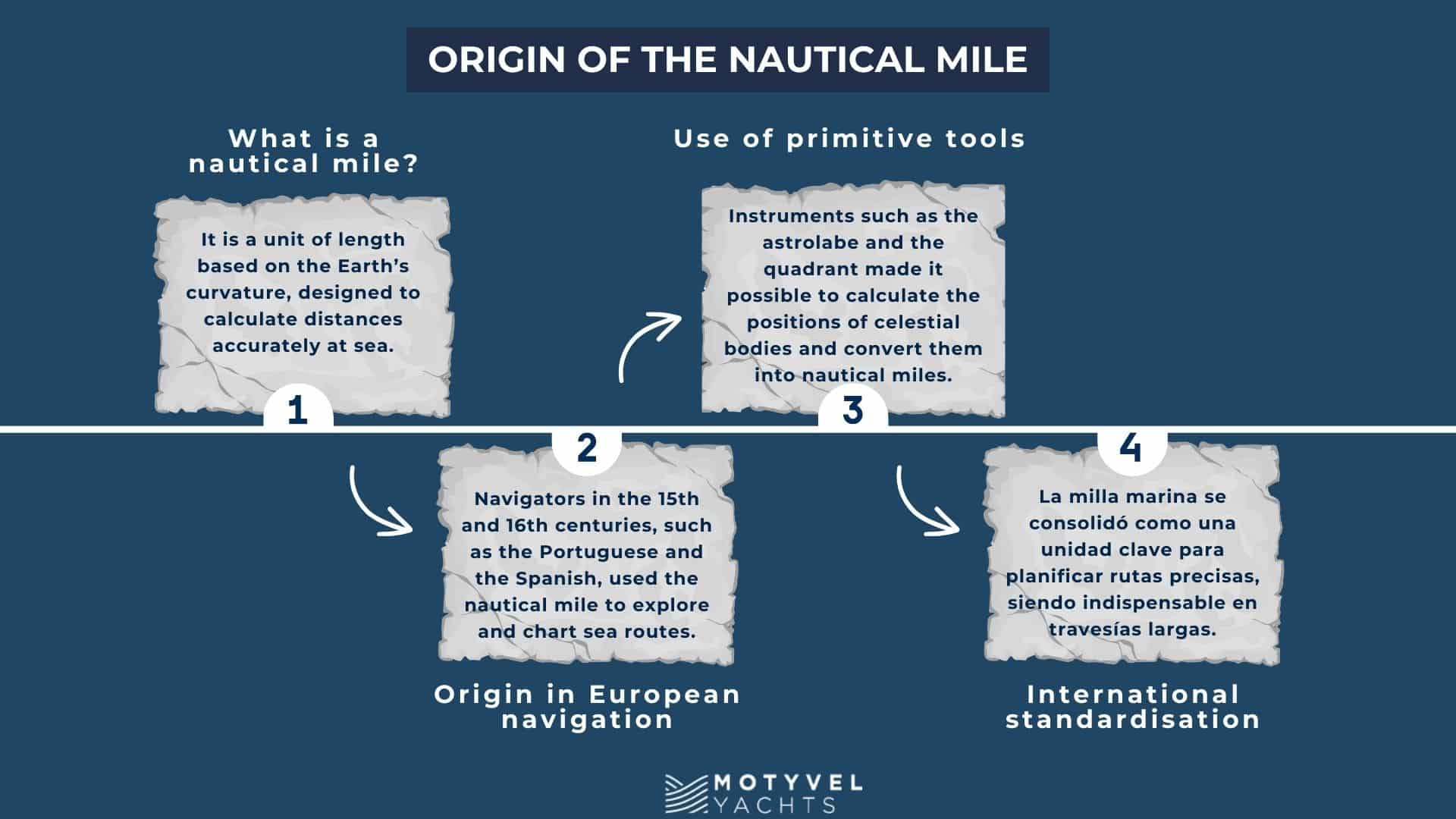
The nautical mile is a unit of length that has been used for centuries in navigation to calculate distances at sea. Unlike other units of measurement, its definition is based on the Earth’s curvature, which makes it especially relevant for navigators. The term comes from the Latin word “milia”, meaning thousand, as it refers to a measure based on degrees of the Earth’s surface.
The first to use the nautical mile were European navigators during the Age of Discovery, in the 15th and 16th centuries. These explorers, such as the Portuguese and the Spanish, needed a precise way to measure the distances they travelled on the high seas in order to draw maps and establish trade routes. They used rudimentary instruments such as the astrolabe and the quadrant to measure the position of the stars and, in this way, calculate distances travelled in nautical miles. Over time, the nautical mile became an indispensable tool for ensuring accuracy on sea journeys, making navigation easier on increasingly complex routes. This is why this measure has become the international standard for maritime navigation, as it makes route calculations more precise, especially on long passages.
How long is a mile at sea?
A nautical mile is equivalent to 1,609.34 metres. This length is based on a subdivision of the Earth’s meridian and corresponds to one minute of arc of longitude. Thanks to this definition, the nautical mile makes it possible to calculate distances at sea with great precision, adapting to the Earth’s roundness. The accuracy of this measure is essential for navigation because it helps reduce errors when estimating a vessel’s position, which can be crucial for safety in adverse conditions.
What is the difference between a nautical mile and a land mile?
Although they share the term “mile”, the difference between a nautical mile and a land mile is significant. The nautical mile, as mentioned above, is equivalent to 1,852 metres, which is where it differs from the land mile. This difference is because the nautical mile is based on the Earth’s geometry, whereas the land mile is a fixed unit used on land. The nautical mile is also commonly used in aviation, as it makes calculations over the planet’s curved surface easier, unlike the land mile, which is used in terrestrial activities.
How many knots is a nautical mile?
The relationship between the nautical mile and knots is direct. One knot is equal to one nautical mile per hour. In other words, if a boat is travelling at 10 knots, it is covering 10 nautical miles every hour. Knots are the unit of speed used at sea, which makes communication and the calculation of times and distances in navigation easier. It is important to bear in mind that speed in knots allows navigators to accurately estimate the duration of a passage and adjust routes according to weather conditions and ocean currents.
How is a nautical mile calculated?
Calculating a nautical mile involves taking into account the Earth’s curvature and geographic coordinates. In practice, navigators use instruments such as the sextant and navigation tables to determine distances and positions. Today, thanks to GPS technology, these calculations are automatic, but it is important to understand how the measure originated and why it is so accurate. The sextant, for example, is an instrument that allows you to measure the angle between a celestial object and the horizon, which helps determine the vessel’s position. Before GPS, navigators relied mainly on these tools, which required great skill and knowledge of astronomy and trigonometry.
Why is it important to know nautical miles if I’m a navigator?
Knowing the nautical mile is essential for any navigator, as it is the basis for all distance and navigation calculations at sea. Understanding how a nautical mile is measured makes it possible to plan routes more accurately, calculate passage times and avoid hazards along the way. In addition, communication between navigators and captains is carried out using these measures, so it is essential for the safety and success of any passage. For example, when a vessel’s position is communicated, the coordinate system and distances in nautical miles are often used, so understanding these measures is vital to avoid misunderstandings that could put the crew’s safety at risk. 
Is it necessary to know nautical miles if I only rent a boat occasionally?
Although it is not strictly necessary to know nautical miles if you only rent a boat from time to time, having a basic understanding can enrich your sailing experience. Knowing how to interpret speed in knots and distances in nautical miles will help you better understand the skipper’s guidance and enjoy safer sailing. What’s more, if you are considering buying a boat, understanding these concepts will allow you to make better-informed decisions. Even for those who enjoy the occasional hire of leisure craft, understanding how distances and speed are calculated can make the experience much more enjoyable and educational, allowing a greater appreciation of the skills needed to handle a vessel on the open sea.
Make your dream of sailing a reality with Motyvel
We can say that the nautical mile is a fundamental measure for anyone interested in navigation. Whether you sail occasionally or you are an experienced navigator, understanding how it is measured and how it is used is key to a good experience at sea. In fact, knowing the nautical mile not only helps improve route planning, it also guarantees the safety and efficiency of every journey, as it allows navigators to better calculate timings, fuel consumption and the necessary stops.
At Motyvel, we have extensive experience to guide you along this exciting path. If you are thinking about getting more involved in the world of sailing, we invite you to explore our selection of leisure boats and large yachts, where you will find options that meet the highest standards of quality and performance, designed to provide you with an unforgettable sailing experience. Contact us now, our team of experts will be happy to advise you and help you find the perfect boat for your needs. Start your adventure at sea today.