When boarding a sailing yacht, many people focus on learning how to manoeuvre without paying attention to something extremely important: the wind. Did you know that understanding wind direction can completely change the way you sail and your safety at sea? Understanding the relationship between the boat and the wind, especially concepts such as windward and leeward, is essential for every sailor.
That’s why, at Motyvel, where we have spent over 35 years supporting sailors with boats and yachts from the most prestigious brands, we explain the differences between windward and leeward so you can face your next sea adventure with complete confidence.
What do windward and leeward mean?
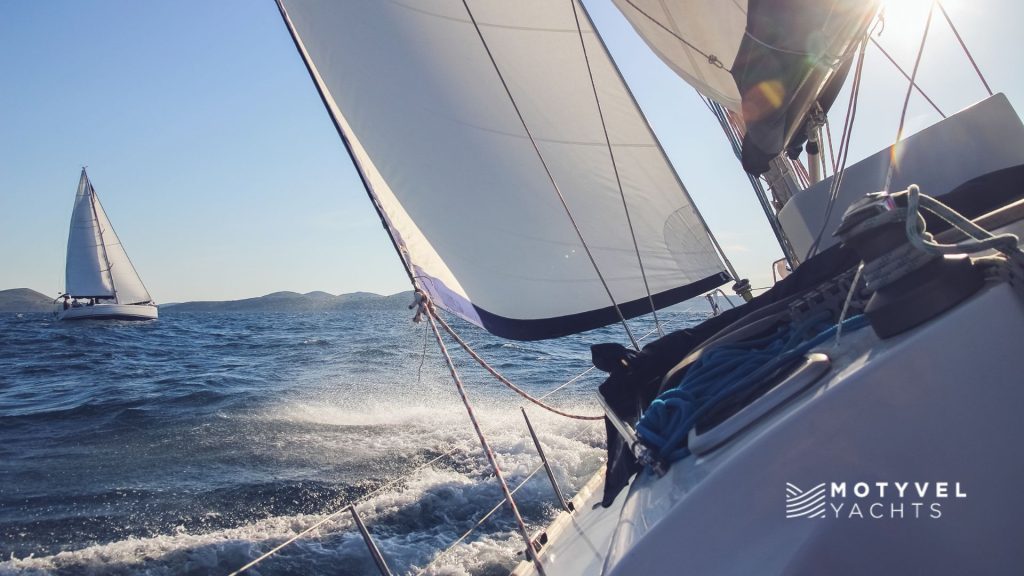
In sailing, windward and leeward describe the relative position of any object in relation to the wind:
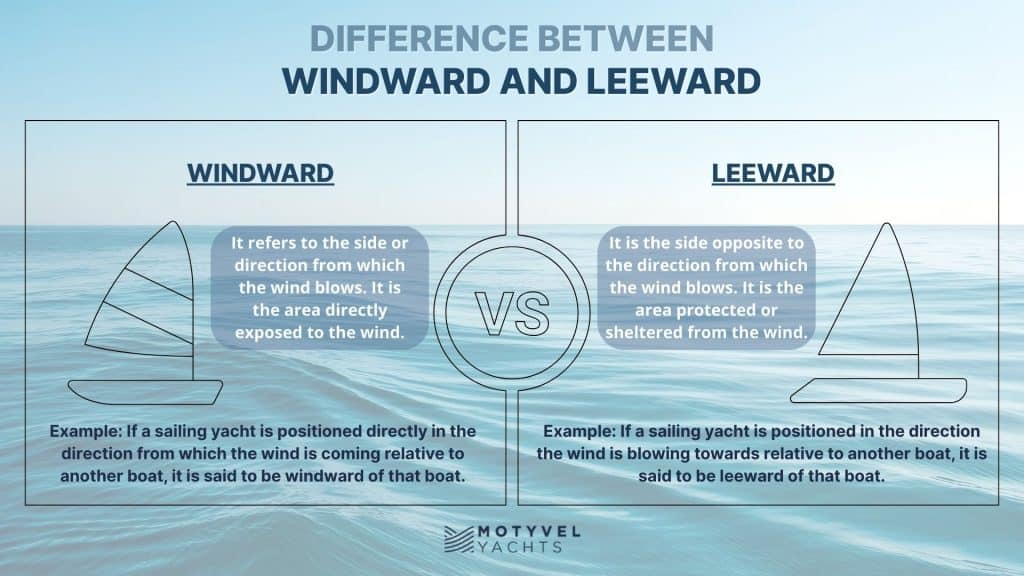
- Windward: the side from which the wind blows; the area exposed to the wind.
- Leeward: the side opposite the wind; the area protected or sheltered from the wind.
What is the difference between windward and leeward?
Although windward and leeward are opposite and complementary concepts, for a sailor the difference goes far beyond simply “wind ahead” or “wind from behind”. It defines how the boat behaves, how you should manoeuvre and how you read what is happening around you.
Relative position to the wind
The first difference is purely geometrical:
- Windward: the area you face when you look directly into the wind.
- Leeward: the area towards which the wind is pushed once it has passed over the boat, a sail, an island or any obstacle.
In practice, every time you change the boat’s course, you also change which side is windward and which is leeward.
Influence on sailing manoeuvres
The difference between windward and leeward affects many manoeuvres:
- Approaching a harbour or pontoon
- On both motorboats and sailing yachts, the most common approach is with the wind ahead or slightly from windward. This gives greater control over speed and braking.
- If you enter with the wind from astern (leeward wind), the boat will tend to accelerate precisely when you need the most control, which makes the manoeuvre much more difficult.
- On both motorboats and sailing yachts, the most common approach is with the wind ahead or slightly from windward. This gives greater control over speed and braking.
- Passing close to a headland or an island
- On the windward side of a headland there is usually more swell and stronger gusts.
- On the leeward side you may find calmer waters, but also irregular wind and turbulent gusts.
- On the windward side of a headland there is usually more swell and stronger gusts.
- Racing
In competition, being positioned windward or leeward relative to other boats determines key tactical decisions, especially at the start and during mark roundings.
Impact on stability and speed
Any sailing yacht is affected by these two aspects:
- On courses close to windward:
- The boat heels more.
- Speed through the water can be good, but progress towards the destination requires careful angle calculation to avoid having to tack too often.
- The boat heels more.
- On courses towards leeward (beam reach, broad reach, running):
- Heel is usually reduced, especially with well-trimmed sails.
- It is easier to maintain higher speeds, but you must monitor directional stability and the risk of accidental gybes.
- Heel is usually reduced, especially with well-trimmed sails.
How they affect sail trim
On a sailing yacht, sails are always trimmed with reference to windward and leeward:
- To windward, sails work more close-hauled; sheets are trimmed in tighter and the sail shape is flatter.
- Towards leeward, on more open courses, sails are eased, opened outwards and the sail shape is fuller.
How to tell whether it is windward or leeward
1. Feel the wind on your own body
The most direct method:
- Go out to the cockpit or the deck.
- Close your eyes for a moment and notice which direction the wind hits your face from.
- Turn your body until you receive it head-on: you are facing windward.
- The side of your body facing the wind is the windward side; the opposite side is leeward.
2. Look at the wind vane or Windex at the masthead
Almost all cruising yachts have a wind vane or Windex at the top of the mast.
- This arrow shows where the apparent wind is coming from.
- If you mentally transfer that direction to the boat’s layout, the side the arrow “points” towards is windward.
- The opposite side is leeward.
3. Observe the sails
The sails also “show” where windward and leeward are:
- The side of the sail that receives the wind directly (where it often flaps if you ease the sheet) corresponds to the windward side of the sail.
- The opposite side, where airflow is faster and generates lift, relates to the leeward side of the sail.
4. Take the coast, headlands and islands into account
The concepts of windward and leeward also apply to the coast:
- The side of an island where the wind hits is windward.
- The opposite, sheltered side is leeward.
Who has right of way: the windward boat or the leeward boat?
The answer is found in the rules, both for racing and for recreational navigation.
General rule between two sailing yachts
When two sailing yachts receive the wind on the same side (that is, they are on the same tack), the leeward boat has right of way over the windward boat. This means:
- The leeward boat is the “right-of-way boat”: it may maintain its course and speed.
- The windward boat is the “keep-clear boat”: it must alter course or speed to avoid a collision.
Relation to tacks: starboard and port
In addition to windward and leeward, right-of-way rules refer to boats on starboard or port tack:
- A sailing yacht is on starboard tack when the wind comes over the starboard side (therefore, its windward side is starboard).
- It is on port tack when the wind comes over the port side.
The basic rule states that:
- The yacht on starboard tack has right of way over the one on port tack.
In racing: windward and leeward in action
In racing, the relationship between windward and leeward becomes especially visible at the start and around the marks:
- On the starting line, the leeward boat may “defend” its position by luffing up (heading closer to the wind), provided it leaves room for the windward boat to keep clear.
- At leeward marks, the rules specify which boat is entitled to room to manoeuvre depending on its inside or outside position and its entry into the three-length zone.
In recreational sailing and in harbours
Outside competition, for a recreational skipper sailing with family or friends, the real priority must always be safety. Even if the rules indicate that the leeward boat has right of way, it is important to remember other points:
- Within a harbour, commercial vessels (ferries, cargo ships, tugboats, etc.) have priority over recreational craft, even if these are sailing yachts.
- The International Regulations for Preventing Collisions at Sea (COLREGs) state that, even when entitled to right of way, a vessel must do everything possible to avoid a collision.
Ready to sail?
If you want to experience and practise these manoeuvres, these two boats are perfect for your next voyages:
Jeanneau Sun Odyssey 415
Designed for those seeking to sail with elegance, comfort and safety, without sacrificing performance. With an overall length of 12.35 m, a modern design and a carefully planned interior layout, it offers bright, welcoming spaces (spacious saloon, “L”-shaped galley, smart storage solutions and several possible cabin configurations), making it an ideal option for both relaxed cruising and true seafaring adventures.
In addition, its hull built to high-quality standards, together with adaptable keel options (standard or shoal draft for shallow waters), its twin rudders and its ergonomic cockpit and deck layout make manoeuvring easier and provide excellent sailing performance.
Jeanneau Sun Odyssey 350
This is a compact and very well-designed sailing yacht, intended for those who want to enter the world of sailing without giving up comfort, manoeuvrability and performance. With an overall length of around 10.40 m, a beam of 3.59 m and a modern design that maximises space both on deck and below, it offers a perfect balance between ease of handling and onboard comfort.
Its hull and configuration allow smooth movement on deck, along with agile handling at the helm: ideal for sailing as a couple, with family or with a small crew.
Sail with confidence and control
Mastering the meaning of windward and leeward goes far beyond passing a theoretical exam. It helps you read the wind and sea conditions more accurately, understand how your boat will react on each course, adjust sails and manoeuvres with greater confidence, and interpret who has right of way while anticipating the movements of other boats.
With bases in Barcelona and the Balearic Islands, at Motyvel you will find expert advice to choose the boat that best suits your sailing style. To put into practice everything you have learned about windward and leeward, take a look at our available units and contact us for more information.